GERMANY FROM ABOVE
2nd Season
Episode 4: Cities
“Germany From Above 2” presents the history and beauty of this country through breathtaking aerial footage and animations. The aerial perspective shifts between sweeping heights and intimate close-ups to the faces of the people and the animals who call Germany home.
An aerial scan of the country — idyllic landscapes and ‘science fiction-like’ imagery taken from satellite and other high-tech monitoring equipment. This is the contemporary version of the Heimatfilm: a breathtaking high-definition journey over a country stretching from the Wadden Sea to the Alps, from the Rhine to the Elbe, and across the mining regions of the Ruhr.
Germany is covered by a network of cities — from the ten largest, Berlin, Hamburg, Munich, Cologne, Frankfurt, Stuttgart, Düsseldorf, Dortmund, Essen and Bremen, to hundreds of small and medium-sized cities. Some 85% of all Germans live in urban areas. But why do Germans choose to live in such close proximity?
Audiences fell in love with the first season of the ZDF series Germany From Above in the Terra X slot. In the second season, we look down on Germany’s cities from above and uncover fascinating secrets aboard the country’s unique Zeppelin. A team from the Jülich Research Centre measures the distribution of atmospheric pollutants from the airship — is the air over Frankfurt, or above BASF’s vast chemical complex in Ludwigshafen, really worse than over the Black Forest or Freiburg?
Aerial archaeologist Klaus Leidorf identifies the buried remains of Germany’s oldest cities. Manching, in Upper Bavaria near Ingolstadt, was a major settlement in Celtic times. Up to 10,000 people lived here during the Iron Age, making it one of the most populous places north of the Alps.Thanks to local iron ore deposits, this Celtic city became a centre of the iron industry, strategically positioned along the Danube trade routes. Klaus Leidorf can trace seven kilometres of the ancient city wall of Manching — proof that even in the Iron Age, cities were places of wealth and culture. But why did the oppidum of Manching disappear centuries before the Romans came?
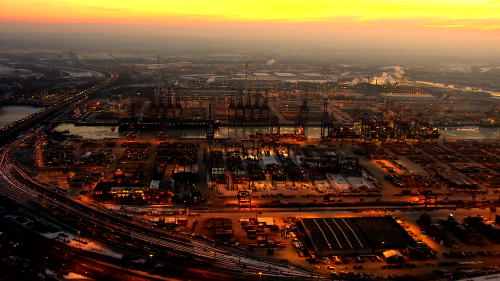
Almost all of Germany’s great cities were born in ancient times — in the Roman era or during the High Middle Ages — and have defended their position ever since. Cities founded by the Romans, such as Cologne or Mainz, grew along garrison routes. Cities like Bamberg or Münster remained important episcopal seats for centuries. Port cities like Bremen, Hamburg and Duisburg on the Rhine fought for centuries to maintain access to the sea, constantly adapting to ever-larger ships or relocating when floods shifted the river’s course. In the Ruhr, former steel giants like Dortmund and Essen are reinventing themselves after deindustrialisation, becoming magnets for a younger generation. Cities seem as tenacious as old trees — and from above you can see their growth rings. But why do we keep returning to the same places, even long after their original purpose has faded? And when does a place tip over into a ghost town — like ancient Manching?”
From above, even a city as vast as Cologne reveals unexpected aspects. Where do we bury our dead in cities? In Cologne you can make out an entire city of the dead. Over the centuries, German cities buried their dead in different places at different times: at the heart of the city beside the church, then outside the city walls — especially during the great plagues. And so cemeteries migrated across the centuries, leaving their traces behind.
The Second World War brought the most radical change to German cities. Hamburg, Dresden, Cologne, Dortmund, Nuremberg and Stuttgart were levelled between 1943 and 1945. At that time citizens faced a choice: how much of the old medieval fabric to preserve, or whether to build an entirely modern city. Today we long for the old. We love tall windows and stucco-decorated facades — so heavily damaged during the war. Some cities, like Nuremberg and Münster, chose to rebuild certain areas much as they had looked in the Middle Ages, if somewhat simplified. Today they evoke a nostalgic sense of better times. In Dresden it took many decades before the Frauenkirche was finally rebuilt — and this celebrated historic landmark has now been laser-scanned from a helicopter.
Other German cities were planned at the drawing board and built from scratch: the Kings of Baden commissioned planned cities such as Karlsruhe, Mannheim and Freudenstadt, while new towns like Wolfsburg and Eisenhüttenstadt were created by Germany’s two dictatorships — under the Nazis and the GDR.
From above, you can see the fashions and contradictions of city planning in cities like Berlin or Munich — and sometimes you can literally feel them. In Berlin, for instance, distinct heat zones are measurable from the air, with some areas running up to 5° hotter than others in summer.
The UNESCO city of Bamberg is known as the German Rome for its seven hills, while Bremen is considered the most British of German cities and consistently ranks among the country’s most liveable. Both are a feast for the eyes, whatever the perspective. It is a blend of history, chance and planning regulations that shapes what we love about a city. The small medieval town of Nördlingen in Swabia — once a free imperial city — is the perfect time capsule: a place where fields still lay within the city walls, cemeteries occupied the centre, and sewerage, refuse collection and electricity had yet to make their mark.
An aerial scan of the country — idyllic landscapes and ‘science fiction-like’ imagery taken from satellite and other high-tech monitoring equipment. This is the contemporary version of the Heimatfilm: a breathtaking high-definition journey over a country stretching from the Wadden Sea to the Alps, from the Rhine to the Elbe, and across the mining regions of the Ruhr.
Germany is covered by a network of cities — from the ten largest, Berlin, Hamburg, Munich, Cologne, Frankfurt, Stuttgart, Düsseldorf, Dortmund, Essen and Bremen, to hundreds of small and medium-sized cities. Some 85% of all Germans live in urban areas. But why do Germans choose to live in such close proximity?
Audiences fell in love with the first season of the ZDF series Germany From Above in the Terra X slot. In the second season, we look down on Germany’s cities from above and uncover fascinating secrets aboard the country’s unique Zeppelin. A team from the Jülich Research Centre measures the distribution of atmospheric pollutants from the airship — is the air over Frankfurt, or above BASF’s vast chemical complex in Ludwigshafen, really worse than over the Black Forest or Freiburg?
Aerial archaeologist Klaus Leidorf identifies the buried remains of Germany’s oldest cities. Manching, in Upper Bavaria near Ingolstadt, was a major settlement in Celtic times. Up to 10,000 people lived here during the Iron Age, making it one of the most populous places north of the Alps.Thanks to local iron ore deposits, this Celtic city became a centre of the iron industry, strategically positioned along the Danube trade routes. Klaus Leidorf can trace seven kilometres of the ancient city wall of Manching — proof that even in the Iron Age, cities were places of wealth and culture. But why did the oppidum of Manching disappear centuries before the Romans came?
Almost all of Germany’s great cities were born in ancient times — in the Roman era or during the High Middle Ages — and have defended their position ever since. Cities founded by the Romans, such as Cologne or Mainz, grew along garrison routes. Cities like Bamberg or Münster remained important episcopal seats for centuries. Port cities like Bremen, Hamburg and Duisburg on the Rhine fought for centuries to maintain access to the sea, constantly adapting to ever-larger ships or relocating when floods shifted the river’s course. In the Ruhr, former steel giants like Dortmund and Essen are reinventing themselves after deindustrialisation, becoming magnets for a younger generation. Cities seem as tenacious as old trees — and from above you can see their growth rings. But why do we keep returning to the same places, even long after their original purpose has faded? And when does a place tip over into a ghost town — like ancient Manching?”
From above, even a city as vast as Cologne reveals unexpected aspects. Where do we bury our dead in cities? In Cologne you can make out an entire city of the dead. Over the centuries, German cities buried their dead in different places at different times: at the heart of the city beside the church, then outside the city walls — especially during the great plagues. And so cemeteries migrated across the centuries, leaving their traces behind.
The Second World War brought the most radical change to German cities. Hamburg, Dresden, Cologne, Dortmund, Nuremberg and Stuttgart were levelled between 1943 and 1945. At that time citizens faced a choice: how much of the old medieval fabric to preserve, or whether to build an entirely modern city. Today we long for the old. We love tall windows and stucco-decorated facades — so heavily damaged during the war. Some cities, like Nuremberg and Münster, chose to rebuild certain areas much as they had looked in the Middle Ages, if somewhat simplified. Today they evoke a nostalgic sense of better times. In Dresden it took many decades before the Frauenkirche was finally rebuilt — and this celebrated historic landmark has now been laser-scanned from a helicopter.
Other German cities were planned at the drawing board and built from scratch: the Kings of Baden commissioned planned cities such as Karlsruhe, Mannheim and Freudenstadt, while new towns like Wolfsburg and Eisenhüttenstadt were created by Germany’s two dictatorships — under the Nazis and the GDR.
From above, you can see the fashions and contradictions of city planning in cities like Berlin or Munich — and sometimes you can literally feel them. In Berlin, for instance, distinct heat zones are measurable from the air, with some areas running up to 5° hotter than others in summer.
The UNESCO city of Bamberg is known as the German Rome for its seven hills, while Bremen is considered the most British of German cities and consistently ranks among the country’s most liveable. Both are a feast for the eyes, whatever the perspective. It is a blend of history, chance and planning regulations that shapes what we love about a city. The small medieval town of Nördlingen in Swabia — once a free imperial city — is the perfect time capsule: a place where fields still lay within the city walls, cemeteries occupied the centre, and sewerage, refuse collection and electricity had yet to make their mark.

Facts
Awarded the German Camera Prize (Deutscher Kamerapreis)
First aired 15th May 2011, 7.30pm on ZDF
Credits
Written, directed and produced by: Petra Höfer and Freddie Röckenhaus
Aerial Photography: Peter Thompson
Director of Photography: Marcus von Kleist, Ingmar Lindner u.a.
Video Editor: Jörg Wegner, Maren Grossmann
Producer: Friederike Schmidt-Vogt, Kay Schlasse, Francesca D`Amicis, Johannes Fritsche
Line Producer: Svenja Mandel
Narration: Leon Boden
Commissioning Editors: Alexander Hesse (ZDF), Katharina Rau (ZDF)
A colourFIELD production commissioned by ZDF