


GERMANY FROM ABOVE
3rd Season
Episode 9: Waters
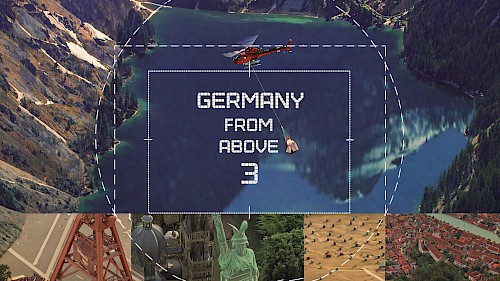
The legendary chalk cliffs of Rügen, Germany’s most famous Baltic island, are now being measured from the air. Laser scans help predict where landslides may occur. At the renowned Cape Arkona, the last remains of the medieval Tempelburg are slowly sinking into the sea. Germany From Above 3 follows archaeologists at work along the Baltic coast — where inland waters and shorelines reveal a breathtaking beauty from above: the islands and Bodden lagoons, the wetlands and sandy beaches have almost a Californian feel, and on sunny days shimmer with the turquoise of the Caribbean Sea.
On the North Sea, millions of euros are invested every year to prevent Germany’s favourite holiday islands from being washed away by the tides. Germany From Above 3 traces past and future changes to the coastline from Borkum to Sylt — an endless battle against storm surges and shifting sands. The series also takes to the air alongside the helicopter crews who winch pilots down onto vast cargo ships in the midst of storms and towering waves.
Germany’s rivers have been tamed over the centuries — their riverbeds dug out and straightened, and dams built along the banks. A flight over the original river area reveals what has been lost: from the gorges at the headwaters of the Danube to the Baden jungle along the Rhine. In the Ruhr, rivers were long used as little more than open sewers for the mining industry. Today, artificial underground channels are being constructed so that even the old wastewater drain of the Emscher is being restored to a clean, natural river.
Almost all of Germany’s major rivers and lakes — from the glacial valley rivers to the Baltic Sea — were formed at the end of the Ice Age, when meltwater from the retreating glaciers carved its way to the sea. Through satellite animation we travel back 250,000 years to the Saalian glaciation, when ice sheets rose as high as Berlin’s TV Tower and the castle of Neuschwanstein.
On the North Sea, millions of euros are invested every year to prevent Germany’s favourite holiday islands from being washed away by the tides. Germany From Above 3 traces past and future changes to the coastline from Borkum to Sylt — an endless battle against storm surges and shifting sands. The series also takes to the air alongside the helicopter crews who winch pilots down onto vast cargo ships in the midst of storms and towering waves.
Germany’s rivers have been tamed over the centuries — their riverbeds dug out and straightened, and dams built along the banks. A flight over the original river area reveals what has been lost: from the gorges at the headwaters of the Danube to the Baden jungle along the Rhine. In the Ruhr, rivers were long used as little more than open sewers for the mining industry. Today, artificial underground channels are being constructed so that even the old wastewater drain of the Emscher is being restored to a clean, natural river.
Almost all of Germany’s major rivers and lakes — from the glacial valley rivers to the Baltic Sea — were formed at the end of the Ice Age, when meltwater from the retreating glaciers carved its way to the sea. Through satellite animation we travel back 250,000 years to the Saalian glaciation, when ice sheets rose as high as Berlin’s TV Tower and the castle of Neuschwanstein.
Facts
First aired 1st June 2013, at 7.30pm on ZDF
Credits
Written, directed and produced by: Petra Höfer and Freddie Röckenhaus
Aerial Photography: Peter Thompson, Irmin Kerck
Director of Photography: Tobias Kaufmann, Stephan de Leuw, Richard Koburg, Moritz Bauer, Marcus von Kleist u.a.
Video Editor: Johannes Fritsche
Producer: Kay Schlasse, Susanne Rostosky, Francesca D’Amicis, Silke Bojahr
Line Producer: Svenja Mandel
Narration: Leon Boden
Commissioning Editor: Friederike Haedecke (ZDF)
A colourFIELD production commissioned by ZDF


