


GERMANY FROM ABOVE
4th Season
Episode 10: Cities
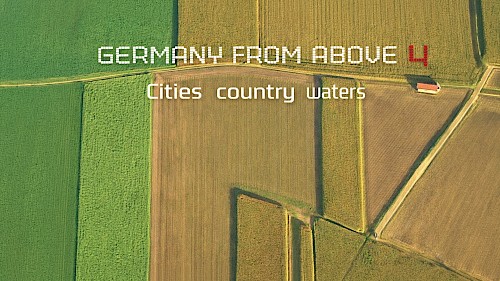
Unique aerial images of Germany – once again as striking and beautiful as ever. The bird‘s eye perspective adds new light to German cities, from Roman founded Trier to former colour capital Erfurt, from the impact of train tracks back to first settlements in the stone age. Geography have never been more intriguing and entertaining than here.
Many hundreds of years ago, people liked to settle in big cities as they do today. One of the oldest and the biggest Roman cities in the German territory is Trier. With sophisticated CGI animation we reawaken the past and show what is left today of the Roman Trier – and why it is so. Erfurt too can look back at a proud history. Camp fires already burnt in the Stone Age and Germanic populations settled along the Gera River. In the Middle Ages, Erfurt was the fourth largest city in Germany after Cologne, Nuremberg, and Magdeburg. Erfurt owned the monopoly on blue pigment. But when India and America – and indigo – were discovered, the city lost its dominant position. We show through CGI the stages of Erfurt’s growth and its trade connections.
Krämerbrücke, Erfurt’s Merchants’ Bridge is still the only bridge north of the Alps to be built entirely over with houses. Its floating houses along the bridge can best be seen from above. Yet we owe German modern cities not only to the Romans and flourishing trade in the Middle Ages.
Steam engines and train stations radically transformed small villages into influential cities – or they determined the decline of cities. The medieval city of Dinkelsbühl has been living in a time bubble since the railway cut off this once influential city. We show with CGIs the amazing growth of the railway network, we follow the helicopter of the Deutsche Bahn measuring with lasers between Cologne and Düsseldorf from the air. We look at how the ICE tracks of the high-speed trains in Thuringia are built, right alongside the 90 meter high masts of the new high voltage power lines, where helicopters position the cables of the controversial new long-distance power lines.
Probably the most special network of otherwise invisible connections between two major cities is woven by the travel routes of soccer fans travelling over the Easter Holiday to see the match of all matches in Germany: Borussia Dortmund versus Bayern Munich. The CGI animation sequence of that matchday was the biggest Facebook hit for ZDF Terra X.
Many hundreds of years ago, people liked to settle in big cities as they do today. One of the oldest and the biggest Roman cities in the German territory is Trier. With sophisticated CGI animation we reawaken the past and show what is left today of the Roman Trier – and why it is so. Erfurt too can look back at a proud history. Camp fires already burnt in the Stone Age and Germanic populations settled along the Gera River. In the Middle Ages, Erfurt was the fourth largest city in Germany after Cologne, Nuremberg, and Magdeburg. Erfurt owned the monopoly on blue pigment. But when India and America – and indigo – were discovered, the city lost its dominant position. We show through CGI the stages of Erfurt’s growth and its trade connections.
Krämerbrücke, Erfurt’s Merchants’ Bridge is still the only bridge north of the Alps to be built entirely over with houses. Its floating houses along the bridge can best be seen from above. Yet we owe German modern cities not only to the Romans and flourishing trade in the Middle Ages.
Steam engines and train stations radically transformed small villages into influential cities – or they determined the decline of cities. The medieval city of Dinkelsbühl has been living in a time bubble since the railway cut off this once influential city. We show with CGIs the amazing growth of the railway network, we follow the helicopter of the Deutsche Bahn measuring with lasers between Cologne and Düsseldorf from the air. We look at how the ICE tracks of the high-speed trains in Thuringia are built, right alongside the 90 meter high masts of the new high voltage power lines, where helicopters position the cables of the controversial new long-distance power lines.
Probably the most special network of otherwise invisible connections between two major cities is woven by the travel routes of soccer fans travelling over the Easter Holiday to see the match of all matches in Germany: Borussia Dortmund versus Bayern Munich. The CGI animation sequence of that matchday was the biggest Facebook hit for ZDF Terra X.
Facts
First aired on Sunday, 17th May 2015, 19:30 pm, ZDF
Duration: 45 minutes
Credits
Written, directed and produced by: Petra Höfer and Freddie Röckenhaus
Aerial Photography: Peter Thompson, Irmin Kerck, Stefan Urmann
Director of Photography: Jarno Cordia, Tobias Corts, Tobias Kaufmann, Sebastian Meien, Oliver Köppel
Video Editor: Johannes Fritsche
Producer: Susanne Rostosky, Kay Schlasse, Francesca D’Amicis
Line Producer: Franziska Gößling, Svenja Mandel
Narration: Leon Boden
Commissioning Editors: Friederike Haedecke (ZDF), Katharina Kohl (ZDF)
A colourFIELD production commissioned by ZDF


