GERMANY FROM ABOVE
4th Season
Episode 11: Country
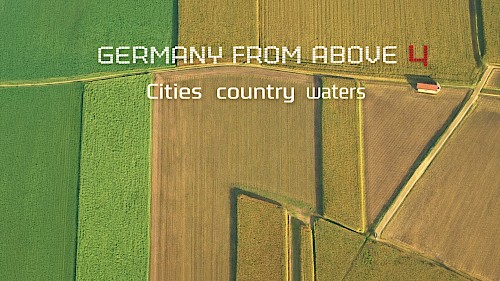
Natural beauties show their most spectacular side when viewed from above. The second episode of “Germany From Above 4“ takes us to the countryside – over fields, woods, and wilderness. Pristine nature is quite rare since many natural environments are man-made.
The “Monte Kali“ near Heringen is, for instance, the highest artificial German mountain. The perfect symmetry of the farmer-made hop fields in Bavarian Holledau reveal their magic when seen from above.
Hikers are charmed not only by wild landscapes like the Höllentalklamm at the Zugspitze mountain. In 2014 a large 75-metre crop circle near the radome at Raisting in Bavaria attracted curiosity-seekers from around the world to the Ammersee. We captured these science fiction shapes and their visitors from the ideal perspective: from above. Yet no matter how intergalactic a redesigned field can be, it is still quite an extraordinary experience when you see the throughly hidden, earthly inhabitants of meadows and woods. Near the river Main in Franconia, we encounter those flying artists at eye level that dwell only in healthy forests with clean water: the black storks.
We fly with two black stork parents as they give flying lessons to their young chick, and see the flying territory with real GPS data. Just like we tracked the journey of a female wolf born in a military training camp near Magdeburg who wandered almost as far as Hamburg.
The Northern Bald Ibis was hunted to extinction in Germany in the 17th century. Now their descendants, kept in zoos and born in captivity are brought back to the wild. Yet this odd-looking bird must learn the migration route from Germany to Italy from their human “parents“ flying on an ultra-light aircraft. We joined the young Ibises on their training sessions in the Berchtesgadener Land, one of the most spectacular natural landscapes in Germany.
Much smaller flying and orientation wizards also have a place in “Germany From Above“. We show how bees have a kind of “map-memory“ of the countryside. We film these flying honey-makers with a high-speed camera and then simulate their flight with a drone. The images are then transformed into the way scientists believe bees see the world.
The “Monte Kali“ near Heringen is, for instance, the highest artificial German mountain. The perfect symmetry of the farmer-made hop fields in Bavarian Holledau reveal their magic when seen from above.
Hikers are charmed not only by wild landscapes like the Höllentalklamm at the Zugspitze mountain. In 2014 a large 75-metre crop circle near the radome at Raisting in Bavaria attracted curiosity-seekers from around the world to the Ammersee. We captured these science fiction shapes and their visitors from the ideal perspective: from above. Yet no matter how intergalactic a redesigned field can be, it is still quite an extraordinary experience when you see the throughly hidden, earthly inhabitants of meadows and woods. Near the river Main in Franconia, we encounter those flying artists at eye level that dwell only in healthy forests with clean water: the black storks.
We fly with two black stork parents as they give flying lessons to their young chick, and see the flying territory with real GPS data. Just like we tracked the journey of a female wolf born in a military training camp near Magdeburg who wandered almost as far as Hamburg.
The Northern Bald Ibis was hunted to extinction in Germany in the 17th century. Now their descendants, kept in zoos and born in captivity are brought back to the wild. Yet this odd-looking bird must learn the migration route from Germany to Italy from their human “parents“ flying on an ultra-light aircraft. We joined the young Ibises on their training sessions in the Berchtesgadener Land, one of the most spectacular natural landscapes in Germany.
Much smaller flying and orientation wizards also have a place in “Germany From Above“. We show how bees have a kind of “map-memory“ of the countryside. We film these flying honey-makers with a high-speed camera and then simulate their flight with a drone. The images are then transformed into the way scientists believe bees see the world.
Facts
First aired Sunday, 24th May 2015, 19:30 pm, on ZDF
Credits
Written, directed and produced by: Petra Höfer and Freddie Röckenhaus
Aerial Photography: Peter Thompson, Irmin Kerck, Stefan Urmann
Director of Photography: Jarno Cordia, Tobias Corts, Tobias Kaufmann, Sebastian Meien, Oliver Köppel
Video Editor: Johannes Fritsche
Producer: Susanne Rostosky, Kay Schlasse, Francesca D’Amicis
Line Producer: Franziska Gößling, Svenja Mandel
Narration: Leon Boden
Commissioning Editors: Friederike Haedecke (ZDF), Katharina Kohl (ZDF)
A colourFIELD production commissioned by ZDF