


GERMANY FROM ABOVE
1st Season
Episode 3: Waters
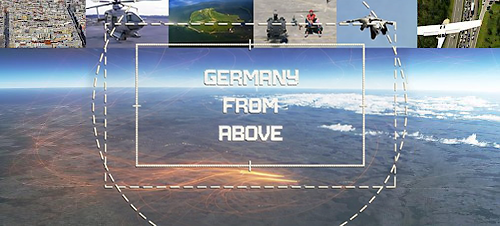
German waters have always been more than just water. The Rhine with its castles, the port of Hamburg, the Elbe, the ebb and flow of the Wadden Sea, the echo of Lake Königssee, the vast expanse of Lake Constance: rivers, seas and lakes are where many Germans feel at home. Seen from above, they reveal an entirely new world.
When National Park scientist Kai Abt and ranger Karl-Heinz Hilderbrandt record seals from the window of their small aircraft, you could think you were flying over the South Seas. Yet in the gleaming sandbanks and turquoise waters of the Wadden Sea, they are not searching for pirate treasure but for seals. Their population has grown precisely because they are protected and monitored from the air in the Wattenmeer National Park. Oil production on Germany’s only offshore platform, Mittelplate, is subject to strict regulations. GPS-based animations show how delicate life is for seals, even in this unique UNESCO landscape. The animation tracks the movements of five seals and every ship crossing the North Sea. At a glance you see it clearly: despite all protected areas, seals cross the paths of huge vessels — because a seal can swim up to 50 kilometres a day in search of food.
Where most of the large ships arrive, a new chapter of this episode begins: the container port in Hamburg is almost fully automated. 52 cranes, 84 transport vehicles and 12 tractor units are controlled by computers and load hundreds of containers. Nine mega container vessels capable of carrying up to 10,000 containers each drop anchor in Hamburg every week, along with countless smaller ships. Goods from around the world are then loaded onto trains and trucks with remarkable efficiency and make their way to our supermarkets. Stock levels are optimised around the clock. Yet only from above can you appreciate the stunning scale and beauty of this endless loading activity.
On the Autobahn, reality strikes back: with a GPS data-based animation of the routes of a mid-sized freight company’s trucks, you can see clearly why transport so often ends up exactly where it annoys us most — in traffic jams.
Christian Tyrok and Thomas Schechtriem repair high-voltage power lines — by helicopter. This is far quicker than using a crane. Where are Germany’s most important power lines? And who ensures that we can switch on the TV, make a coffee or take a hot shower at any hour of the day?
The last episode of Germany From Above deals with rivers and seas in both the literal and metaphorical sense: from the archaeologists diving in Lake Constance in search of prehistoric remains, to the river police monitoring ship traffic on the Elbe from a helicopter; from the departure of the legendary Queen Mary, which never fails to draw thousands of people to Hamburg, to the monitoring of gas pipelines in the Ruhr Valley.
When National Park scientist Kai Abt and ranger Karl-Heinz Hilderbrandt record seals from the window of their small aircraft, you could think you were flying over the South Seas. Yet in the gleaming sandbanks and turquoise waters of the Wadden Sea, they are not searching for pirate treasure but for seals. Their population has grown precisely because they are protected and monitored from the air in the Wattenmeer National Park. Oil production on Germany’s only offshore platform, Mittelplate, is subject to strict regulations. GPS-based animations show how delicate life is for seals, even in this unique UNESCO landscape. The animation tracks the movements of five seals and every ship crossing the North Sea. At a glance you see it clearly: despite all protected areas, seals cross the paths of huge vessels — because a seal can swim up to 50 kilometres a day in search of food.
Where most of the large ships arrive, a new chapter of this episode begins: the container port in Hamburg is almost fully automated. 52 cranes, 84 transport vehicles and 12 tractor units are controlled by computers and load hundreds of containers. Nine mega container vessels capable of carrying up to 10,000 containers each drop anchor in Hamburg every week, along with countless smaller ships. Goods from around the world are then loaded onto trains and trucks with remarkable efficiency and make their way to our supermarkets. Stock levels are optimised around the clock. Yet only from above can you appreciate the stunning scale and beauty of this endless loading activity.
On the Autobahn, reality strikes back: with a GPS data-based animation of the routes of a mid-sized freight company’s trucks, you can see clearly why transport so often ends up exactly where it annoys us most — in traffic jams.
Christian Tyrok and Thomas Schechtriem repair high-voltage power lines — by helicopter. This is far quicker than using a crane. Where are Germany’s most important power lines? And who ensures that we can switch on the TV, make a coffee or take a hot shower at any hour of the day?
The last episode of Germany From Above deals with rivers and seas in both the literal and metaphorical sense: from the archaeologists diving in Lake Constance in search of prehistoric remains, to the river police monitoring ship traffic on the Elbe from a helicopter; from the departure of the legendary Queen Mary, which never fails to draw thousands of people to Hamburg, to the monitoring of gas pipelines in the Ruhr Valley.
Facts
Nominated for the German TV Prize (Deutscher Fernsehpreis) and for Adolf-Grimme-Prize
First aired 30th May 2010 at 19.30 pm on ZDF
Credits
Written, directed and produced by: Petra Höfer and Freddie Röckenhaus
Aerial Photography: Peter Thompson
Director of Photography: Marcus von Kleist, Johannes Imdahl, Thomas Schäfer, Torbrjörn Karvang, Thomas von Kreisler, Hanno Hart u.a.
Video Editor: Jörg Wegner, Maren Grossmann
Producer: Friederike Schmidt-Vogt, Susanne Rostosky, Francesca D`Amicis, Kay Schlasse, Sandra Schmidt
Line Producer: Svenja Mandel
Narration: Leon Boden
Commissioning Editors: Friederike Haedecke (ZDF), Alexander Hesse (ZDF)
A colourFIELD production commissioned by ZDF


